Bluebook Paradox: Why Practice Scores Lie & Decode SAT
Why do Bluebook test scores fluctuate? Learn how the adaptive Digital SAT algorithm works, why easy mistakes hurt more, and how to calculate your true score.
You just finished Bluebook Practice Test #4. You felt confident. You managed your time perfectly. You clicked "Next" on the final question with 30 seconds to spare.
Then the screen flashed: 1320.
Wait. Last week, on Practice Test #3, you scored a 1410 with more mistakes. How is this possible? Did you get stupider in seven days? Or is the test broken?
Welcome to the "Bluebook Paradox."
As we enter the 2026 testing cycle, the most common question landing in our inbox isn't "how do I solve this math problem?" It's "why doesn't my score make sense?"
This isn't just about frustration; it's about strategy. Most students treat the Digital SAT (dSAT) like a linear test where 1 question equals 10 points. That is a dangerous misconception. To break into the 1500+ range, you need to stop treating the test like a scantron and start treating it like the complex, weighted algorithm it is.
In this guide, we're going to look under the hood of the adaptive scoring engine. We'll analyze real student data to explain why your scores fluctuate, and give you a specific protocol to predict your actual test day performance.
 Figure 1: How Module 1 performance determines your routing to Easy or Hard Module 2, affecting your final score range.
The "Hidden" Variable: Item Response Theory (IRT)
In the old paper SAT days, we had a simple formula:
- 58 Math questions.
- Get 55 right.
- Look up "55" on a chart.
- Score = 760.
The Digital SAT killed that chart. It replaced it with Item Response Theory (IRT).
In the dSAT environment, every single question has a specific "weight" based on two factors:
- Difficulty: How likely is a high-performing student to get this wrong?
- Discrimination: How well does this question separate a 700-scorer from a 600-scorer?
The "Easy" Mistake Penalty
Here is the brutal reality: Getting an easy question wrong hurts you more than getting a hard question wrong.
If you miss a question that 90% of students answer correctly, the algorithm penalizes you heavily because it assumes you lack foundational knowledge. If you miss a "Level 5" geometry problem that only 5% of students solve, the penalty is minimal.
Practical Implication: Precision on the first 10 questions of Module 1 is statistically more valuable than agonizing over the final, hardest question of Module 2.
Case Study: The Tale of Two Students
Let's look at real data modeled from our SAT Score Calculator simulations to understand why your Bluebook scores might feel random.
We have two students, Liam and Sophia. Both are taking the Math section. Both make exactly 5 mistakes total.
Liam's Performance (The "Slider" Pattern)
- Module 1: 2 Mistakes (Missed two careless algebra questions early on).
- Routing: The algorithm determines his performance is "borderline." He just barely qualifies for the Harder Module 2, but his baseline score is already capped lower because of the easy misses.
- Module 2 (Hard): 3 Mistakes (Missed three complex questions).
- Final Score: 710
Sophia's Performance (The "Climber" Pattern)
- Module 1: 0 Mistakes (Perfect run).
- Routing: She unlocks the "Ceiling" version of the Harder Module 2. Her floor is already elevated.
- Module 2 (Hard): 5 Mistakes (She struggled with the hardest questions in the bank).
- Final Score: 740
The Insight: Sophia made more mistakes in the hard module, but because she had a perfect foundation in Module 1, her score was 30 points higher. Liam's early mistakes on "easy" questions dragged his weighted average down permanently.
Key Takeaway: Total error count is a vanity metric. Where you make the errors matters significantly more.
Why Bluebook Practice Tests Feel Inconsistent
College Board's official Bluebook exams are the gold standard, but they are not identical.
- Practice Test 4 vs. Practice Test 1: Community consensus and data suggest that Practice Test 4 has a steeper curve in the Math section. The questions are conceptually harder, meaning the "weight" of correct answers is higher, but the penalty for simple errors is also more volatile.
- The "Static" Adaptive Illusion: Bluebook tests are adaptive, but the question bank is finite. On the real test, the bank is massive. If you retake a Bluebook test, you might remember answers, artificially inflating your score and giving you a false sense of security.
The Protocol: How to Analyze Your Bluebook Data
Stop looking at just the final number. To predict your real score, you need to perform a "Weighted Error Audit" after every practice test.
Step 1: Categorize Your Errors
Go through every mistake and label it:
- Type A (Foundational): Early module questions, simple algebra, grammar rules.
- Type B (Concept Gap): Advanced trigonometry, complex vocabulary boundaries.
- Type C (Execution): Misread the question, calculation error, ran out of time.
Step 2: Apply the "Penalty Multiplier"
When estimating your potential score improvement, weigh them differently:
- Type A errors cost you roughly 20-30 points (because they likely affect routing or baseline).
- Type B errors cost you roughly 10 points.
- Type C errors are wildcards but usually behave like Type A errors if they happen early.
Step 3: Run the Simulation
Use an external tool to validate your hypothesis. You can plug your raw numbers into our Digital SAT Score Calculator.
- Input: Select "Digital SAT".
- Experiment: Input your correct answers from Module 1 and Module 2 separately.
- Observation: See how changing just one answer in Module 1 impacts the final range compared to Module 2.
3 Strategies to Stabilize Your Score
If your scores are bouncing between 1350 and 1500, your issue isn't knowledge; it's consistency.
1. The "First 10" Rule
Slow down. Spend an extra 10 seconds per question on the first 10 questions of Module 1. Treat these as "high stakes" questions. Securing a perfect run here ensures you are routed to the upper echelon of the scoring curve.
2. Identify the "Trap" Questions
The dSAT loves "distractor" answers that look right if you skip a step.
- Example: In Math, if the question asks for $2x$, answer choice A will almost always be $x$.
- Fix: Circle what the question is asking for before you solve.
3. Use Third-Party Norming
Don't rely solely on one ecosystem. Bluebook is essential, but adding high-quality third-party questions (like those from Khan Academy or UWorld) helps you verify if you understand the concept or if you just memorized the Bluebook question style.
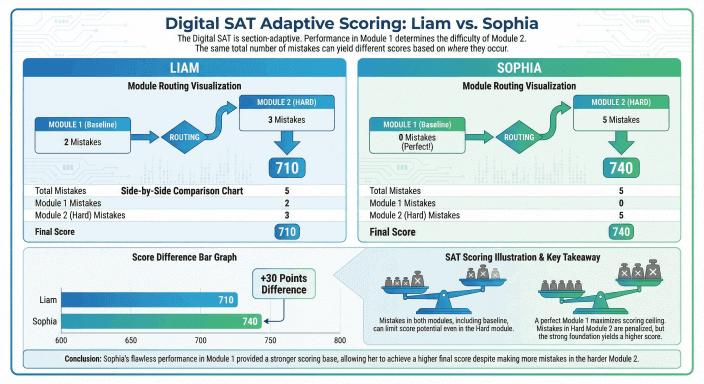 Figure 2: Visualizing how the same number of errors (5 mistakes) can lead to vastly different scores (710 vs 740) based on where mistakes occur in the modules.
Final Thoughts: The Algorithm is Your Friend (If You Respect It)
The Digital SAT isn't trying to trick you; it's trying to place you on a bell curve efficiently.
The "Bluebook Paradox" occurs when you ignore the curve and focus only on the raw number of correct answers. By shifting your focus to weighted accuracy—prioritizing the "easy" foundational questions to secure the Hard Module—you take control of the algorithm.
Don't let a bad practice test define your week. Dig into the data. Was it a Type A error day or a Type B error day? One is a warning signal; the other is just a difficult test.
Ready to see where you stand? Use our free SAT Score Calculator to simulate different scoring scenarios and find your path to a 1500+.
References:
- College Board. "Assessment Framework for the Digital SAT Suite."
- Khan Academy. "Official Digital SAT Prep."
- Internal Data. "SAT Calculator User Session Analysis 2025-2026."
Frequently Asked Questions
Why do my Bluebook practice test scores fluctuate so much?
Bluebook scores fluctuate because the Digital SAT uses adaptive testing. Your performance in Module 1 determines which Module 2 you receive, and easy mistakes in Module 1 can significantly impact your routing and final score, even if you perform well in Module 2.
How does the Digital SAT scoring algorithm work?
The Digital SAT uses Item Response Theory (IRT), where each question has a specific weight based on difficulty and discrimination. Easy questions answered incorrectly hurt your score more than hard questions, and your Module 1 performance determines your Module 2 routing.
What is the 'Bluebook Paradox'?
The Bluebook Paradox refers to the confusing situation where students score differently on practice tests despite making similar numbers of mistakes. This occurs because the adaptive algorithm weights questions differently based on difficulty and routing, not just raw correct answer counts.
How can I predict my actual Digital SAT score?
Use a weighted error audit: categorize mistakes as Type A (foundational, early module), Type B (concept gaps), or Type C (execution errors). Type A errors cost 20-30 points, Type B cost 10 points. Focus on perfecting the first 10 questions of Module 1 to secure better routing.
Why do easy mistakes hurt my score more than hard mistakes?
The algorithm assumes that missing easy questions indicates a lack of foundational knowledge, which heavily impacts your baseline score and routing. Missing hard questions that few students solve has minimal penalty, as it's expected for most test-takers.
Dr. Sarah Chen
Dr. Sarah Chen brings over 12 years of experience in standardized test preparation and educational data analysis. She specializes in analyzing College Board scoring curves and adaptive testing algorithms.
Found this helpful?
Share it with others preparing for the SAT!
Related Articles
How SAT Scores Are Calculated in 2025: Guide
Complete guide to SAT score calculation in 2025: raw to scaled conversion, Digital SAT adaptive modules, paper SAT curves, and practical score estimation strategies for students.
Cracking the Code: 2025 Digital SAT Score Explained
Crack the code behind 2025 Digital SAT scores: understand adaptive module routing, how hard vs easy modules affect scoring, use calculators strategically, and decode percentiles for college admissions success.
Digital SAT 2025 Complete Scoring Guide
A step‑by‑step guide to Digital SAT 2025 scoring: raw→scaled conversions, adaptive modules, section weighting, and practical strategies.
Get More SAT Tips
Get the latest SAT tips and strategies delivered to your inbox