Hidden Math Behind Digital SAT Score Calculation
Learn why Digital SAT questions aren't equal: understand adaptive module routing, IRT scoring, and how Module 1 mistakes cap your score. Get tips for 2025.
If you have recently taken a practice test on the College Board's Bluebook app, or if you've just walked out of a real Digital SAT, you might be feeling a mix of relief and confusion.
The paper test was simple: you answered 58 math questions, missed 5, and looked up your score on a static chart. Simple. Linear. Predictable.
The Digital SAT (DSAT) has thrown that manual out the window.
Now, you might miss 5 questions and get a 760. Your friend might also miss 5 questions but get a 680. Why? Because in the new world of adaptive testing, not all questions are created equal.
This guide will demystify the "Black Box" of the DSAT scoring algorithm. We will explain how the "Module System" works, why "easy" questions are now more dangerous than "hard" ones, and how to use our SAT Score Calculator to predict your performance accurately.
The "Adaptive" Revolution: It's Not About Quantity Anymore
To understand your score, you have to understand the engine running the test. The Digital SAT uses Multistage Adaptive Testing (MST).
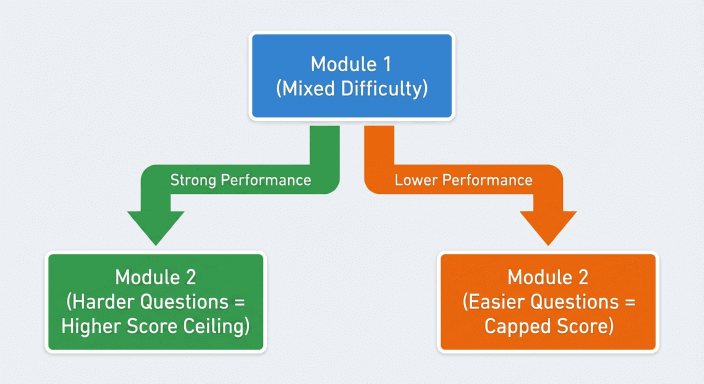
Here is the breakdown that most students miss: The test is divided into two sections: Reading & Writing (RW) and Math. Each section is further split into two Modules.
Module 1 (The Baseline)
Everyone gets a mix of Easy, Medium, and Hard questions. This module determines your "potential."
The Routing Point
Based on how you perform in Module 1, the algorithm "routes" you to a specific version of Module 2.
Module 2 (The Specialized Path)
- The Hard Module: If you did well in Module 1, you face harder questions here. Reward: You can score up to 800.
- The Easy Module: If you struggled in Module 1, you get easier questions here. Penalty: Your score is "capped" (usually around 600-650 max), regardless of how perfect you are in this second half.
The Takeaway: You are not just fighting for points; you are fighting for access to the higher scoring bracket.
The "Careless Mistake" Trap: Why You Can't Afford to Slip
In the old paper SAT, a mistake was a mistake. If you forgot a negative sign on an easy algebra problem, you lost the same number of points as if you blanked on a complex trigonometry question.
On the Digital SAT, careless mistakes are devastating.
Because the test uses Item Response Theory (IRT), the algorithm assigns a "weight" to every question.
High-Weight Questions
Basic concepts that high-performing students should know.
Low-Weight Questions
Extremely obscure or difficult concepts.
If you miss a "High-Weight" (easy) question in Module 1, the algorithm thinks, "Hmm, this student doesn't grasp the basics." It is more likely to route you to the Easy Module 2, effectively capping your score.
Case Study: The Tale of Two Scores
Let's look at a simulation based on real student data to illustrate why manual calculation is impossible.
Student A: The "Sloppy" Genius
- Module 1: Misses 3 easy questions due to rushing.
- Routing: The algorithm doubts their ability and routes them to the Easier Module 2.
- Module 2: Gets 100% correct because the questions are easy.
- Total Errors: 3.
- Estimated Score: 620 (Capped).
Student B: The "Struggling" Strategist
- Module 1: Misses 0 questions. Checks work carefully.
- Routing: Routes to the Harder Module 2.
- Module 2: Misses 5 hard questions because they genuinely didn't know the answers.
- Total Errors: 5.
- Estimated Score: 740.
Look at that difference. Student B missed more questions total but scored 120 points higher. This is why you need a specialized calculator to estimate your score ranges, rather than just counting errors.
How to Use the SAT Calculator for Strategy
Since you can't predict the exact weight of every question, you should use our SAT Score Calculator to run "What-If" scenarios. This helps you build a study strategy.
Scenario 1: "What if I focus on Accuracy vs. Speed?"
Input a scenario where you answer fewer questions but get them all right in Module 1. You will see your projected score floor rise significantly.
- Lesson: Slow down in Module 1. Accuracy is the new speed.
Scenario 2: "The Hard Module Buffer"
Input a scenario where you make it to the Hard Module but miss 4-5 questions. You will likely still see a score in the 700s.
- Lesson: Don't panic if Module 2 feels impossibly hard. That is actually a good sign. It means you made the cut.

3 New Rules for the 2025 Digital SAT
Based on the scoring system, your study habits need to change. Here is what we recommend:
1. Front-Load Your Brain Power
On the old test, you had to survive a marathon. On the DSAT, it's a sprint. The first 15-20 minutes of each section (Module 1) are the most expensive minutes of your life.
- Strategy: Double-check every single answer in Module 1. If you have to guess, save the guessing for the end of Module 2.
2. Master "Desmos"
The DSAT has the Desmos graphing calculator built-in.
- Why it matters: In the "Hard" Module 2, you will face systems of equations that take 5 minutes to solve by hand but 30 seconds to solve on Desmos.
- The Gain: Saving time on hard questions reduces panic, which reduces careless errors.
3. Stop Obsessing Over the "Curve"
Students used to ask, "Was the curve harsh this month?" There is no curve anymore. There is equating. Every student gets a slightly different mix of questions. Your score is based on the difficulty of your specific questions.
- Mindset: You are not competing against other students; you are competing against the algorithm.
Frequently Asked Questions (FAQ)
Q: Can I get a 1600 if I miss a question? A: Yes! Because of the adaptive weighting, it is possible to miss a very difficult "experimental" or "pre-test" question (which doesn't count toward your score) or a low-weight hard question and still score a perfect 800. However, this is rare.
Q: Does the Bluebook app score exactly like the real test? A: It is the closest simulation available, but the real SAT has a much larger bank of questions. The "weighting" on the real test might feel slightly different. Use our calculator to get a range of possibilities based on different difficulty curves.
Q: What happens if I leave a question blank? A: Never leave a question blank. There is no penalty for guessing. If you are running out of time, pick a "Letter of the Day" (like B) and spam it for the remaining questions. A 25% chance is better than 0%.
Final Thoughts: Data is Confidence
The transition to digital testing has removed the transparency of the old "scoring chart," but it has given us a test that is shorter and (arguably) fairer.
Don't let the mystery of the algorithm scare you. Understand that Module 1 is your gateway and Module 2 is your battlefield.
Ready to see where you stand? Stop guessing and start calculating. Use our tools to map out your path to a 1500+.
Check Your Predicted Score Now
📚 References
- The College Board. "The Digital SAT Suite of Assessments Specifications Overview." (2024).
- Assessment in Education Principles. "Item Response Theory (IRT) and Computer Adaptive Testing."
- Compass Education Group. "Digital SAT Scoring: Analysis of the Adaptive Algorithm."
(Disclaimer: The SAT® is a trademark registered by the College Board, which is not affiliated with, and does not endorse, this specific tool or article. Scores generated are estimates based on adaptive testing models.)
Frequently Asked Questions
Can I get a 1600 if I miss a question?
Yes! Because of the adaptive weighting, it is possible to miss a very difficult experimental or pre-test question (which doesn't count toward your score) or a low-weight hard question and still score a perfect 800. However, this is rare.
Does the Bluebook app score exactly like the real test?
It is the closest simulation available, but the real SAT has a much larger bank of questions. The weighting on the real test might feel slightly different. Use our calculator to get a range of possibilities based on different difficulty curves.
What happens if I leave a question blank?
Never leave a question blank. There is no penalty for guessing. If you are running out of time, pick a Letter of the Day (like B) and spam it for the remaining questions. A 25% chance is better than 0%.
SAT Calculator Team
The SAT Calculator Team specializes in data-driven analysis of SAT scoring and college admission trends.
Found this helpful?
Share it with others preparing for the SAT!
Related Articles
Hidden Math of Digital SAT: Why Questions Differ
Learn why Digital SAT questions aren't equal: understand adaptive module routing, IRT scoring, and how Module 1 determines your score ceiling.
Case Study: Why 5 Mistakes Can Mean 680 OR 760
Learn why identical mistake counts can create 100-point score gaps on Digital SAT. Discover adaptive module routing and strategic test-taking rules for 2026.
Mastering Desmos Calculator: Digital SAT Math Secret Weapon
Learn Desmos calculator techniques for Digital SAT Math: intersection, slider, regression methods. Save time and boost your score with visual problem-solving.
Get More SAT Tips
Get the latest SAT tips and strategies delivered to your inbox