Case Study: Why 5 Mistakes Can Mean 680 OR 760
Learn why identical mistake counts can create 100-point score gaps on Digital SAT. Discover adaptive module routing and strategic test-taking rules for 2026.
If you still grade your SAT practice tests by counting "How many did I miss?", you are using a map for a city that no longer exists.
The transition to the Digital SAT (DSAT) has introduced a "Black Box" into the scoring system: Multistage Adaptive Testing (MST). This algorithm has confused thousands of students who walk out of the exam feeling confident, only to receive a score 50 points lower than they expected.
At SatCalculator.online, we didn't just want to guess how this works. We ran simulations using our SAT Score Calculator to analyze the data.
The results were shocking. We found that two students can miss the exact same number of questions but end up with scores that are 100 points apart.
How is this possible? Let's break down the "Hidden Math" that the College Board doesn't explicitly tell you.
The "Fork in the Road": How Routing Works
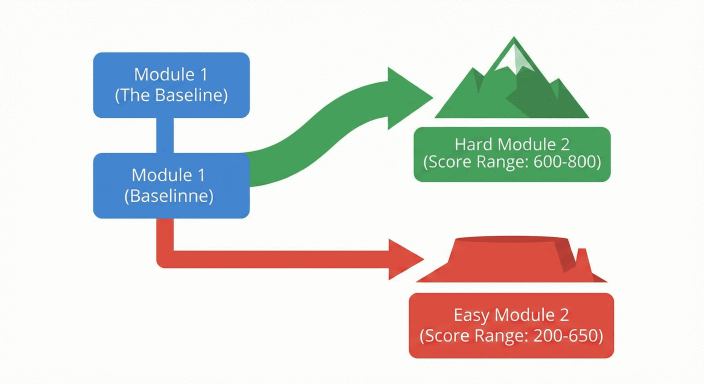
Before we look at the case study, you need to understand the mechanic. The Digital SAT Math section (and Reading/Writing) is split into two modules.
- Module 1: The "Gatekeeper." It contains a mix of Easy, Medium, and Hard questions.
- Module 2: The "Consequence."
- If you perform well in Module 1, you get the Hard Module 2.
- If you make too many mistakes in Module 1, you get the Easy Module 2.
Here is the trap: The Easy Module 2 has a score ceiling. Even if you answer every single question correctly in the Easy Module 2, you mathematically cannot reach a top-tier score (usually capped around 650-660).
The Experiment: Alex vs. Sam
To prove why "accuracy" matters more than "quantity," let's look at two hypothetical students, Alex and Sam.
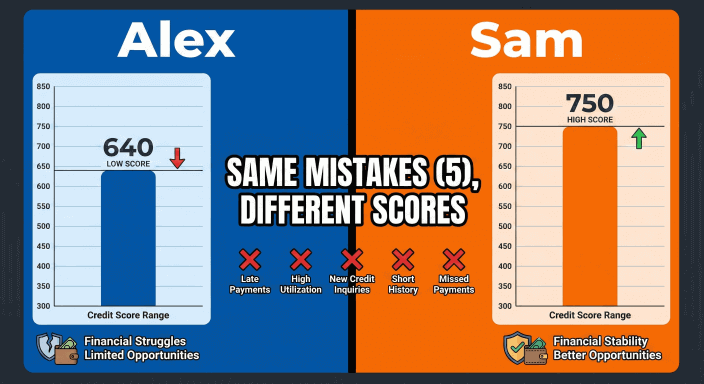
Both students took the same Math section (44 questions total). Both students marked exactly 5 incorrect answers.
On the old paper SAT, they would likely get the same score. On the Digital SAT, they are in different universes.
Student A: "Careless" Alex
- Strategy: Alex rushes. He is good at math but gets sloppy.
- Module 1 Performance: He misses 5 questions. Crucially, 3 of them were "Easy" algebra questions he simply misread.
- The Algorithm's Verdict: "This student struggles with basics."
- Routing: Alex is sent to the Easy Module 2.
- Module 2 Performance: He crushes it. 100% accuracy because the questions are simple.
Student B: "Struggling" Sam
- Strategy: Sam is careful. She double-checks everything in the first section.
- Module 1 Performance: She misses 0 questions. Perfection.
- The Algorithm's Verdict: "This student is ready for a challenge."
- Routing: Sam is sent to the Hard Module 2.
- Module 2 Performance: She hits a wall. The questions are brutal. She misses 5 questions (complex geometry and advanced functions).
The Results (The Data Table)
We plugged these scenarios into our algorithm. Here is the estimated outcome:
| Metric | Student A (Alex) | Student B (Sam) |
|---|---|---|
| Total Mistakes | 5 | 5 |
| Module 1 Score | 17/22 (Low Accuracy) | 22/22 (Perfect) |
| Module 2 Difficulty | Easy (Capped) | Hard (Bonus) |
| Module 2 Score | 22/22 (Perfect) | 17/22 (Low Accuracy) |
| ESTIMATED SCORE | ~640 | ~750 |
The Analysis: Why Did This Happen?
This is the concept of Item Response Theory (IRT) in action. Not all questions are weighted equally.
1. The Penalty of the "Easy" Mistake
Alex's mistakes in Module 1 were expensive. By missing easy questions, he tanked his "ability estimate" immediately. The algorithm determined he didn't qualify for the 700+ range. Once he was routed to the Easy Module, his fate was sealed. He got a perfect score on the second half, but he was essentially running a race where the finish line was moved closer.
2. The "Safety Net" of the Hard Module
Sam struggled significantly in the second half, missing the same number of questions as Alex did in the first half. However, because she unlocked the Hard Module, her score floor was raised. The algorithm knows the questions in Hard Module 2 are difficult, so the penalty for missing them is much smaller than missing an easy question.
Key Takeaway: A 750 score often contains more wrong answers than a 680 score, provided those wrong answers happened in the Hard Module.
3 Strategic Rules to Beat the Algorithm
Now that you know the math isn't fair, you can use it to your advantage. Here is how to adjust your test-taking strategy for 2026.
Rule #1: Treat Module 1 Like a Minefield
You cannot afford to be careless in the first 20 minutes.
- Action: If you usually finish with 5 minutes to spare, use that time to check the easy questions, not the hard ones. Verify your arithmetic.
- Why: An error on Question #3 (basic algebra) hurts you more than an error on Question #22 (hard nonlinear equation).
Rule #2: Don't Panic if Module 2 is Impossible
Many students panic when they start the second module and suddenly can't solve the first three problems.
- Reality Check: If the questions feel incredibly hard, celebrate. It means you made it to the Hard Module. You are now playing for the 700-800 bracket. Even if you guess on a few, you are still likely to score higher than someone who found Module 2 "easy."
Rule #3: Simulate Your Scenarios
Don't guess where you stand. Use our SAT Score Calculator to run "What If" scenarios.
- What happens if I get 100% on Module 1 but 50% on Module 2?
- What happens if I miss 2 questions in Module 1?
Seeing these numbers will give you a realistic picture of your target score range and help you stop obsessing over "total mistakes."

Final Thoughts
The Digital SAT rewards consistency and foundational mastery over lucky guessing. The "Hidden Math" might seem unfair, but it actually favors students who prepare thoroughly.
Your goal is not "zero mistakes." Your goal is "zero careless mistakes in Module 1." Secure your ticket to the Hard Module, and the score will follow.
Ready to see where you stand? Run your own simulation now.
👉 Calculate My Digital SAT Score
📚 References & Data Sources
- College Board Assessment Framework for the Digital SAT Suite.
- Analysis of Bluebook™ Practice Tests 1-6 Scoring Curves.
- Internal user data from SatCalculator.online simulations (2025).
(Disclaimer: This article is based on algorithmic estimates. The College Board's official scoring process involves complex equating that varies by specific test form.)
Frequently Asked Questions
Can the same number of mistakes result in different scores on Digital SAT?
Yes! Two students can miss the exact same number of questions but end up with scores 100 points apart, depending on which module they made mistakes in. Module 1 mistakes are more costly than Module 2 mistakes.
Why does Module 1 matter more than Module 2?
Module 1 determines your routing to either Easy or Hard Module 2. Missing easy questions in Module 1 routes you to Easy Module 2, which has a score ceiling around 650-660, even with perfect Module 2 performance.
What should I focus on during the Digital SAT?
Focus on accuracy in Module 1, especially on easy and medium questions. Use extra time to double-check easy questions rather than rushing to hard ones. Securing Hard Module 2 routing is crucial for high scores.
SAT Calculator Team
The SAT Calculator Team specializes in data-driven analysis of SAT scoring and college admission trends.
Found this helpful?
Share it with others preparing for the SAT!
Related Articles
Hidden Math Behind Digital SAT Score Calculation
Learn why Digital SAT questions aren't equal: understand adaptive module routing, IRT scoring, and how Module 1 mistakes cap your score. Get tips for 2025.
Hidden Math of Digital SAT: Why Questions Differ
Learn why Digital SAT questions aren't equal: understand adaptive module routing, IRT scoring, and how Module 1 determines your score ceiling.
Mastering Desmos Calculator: Digital SAT Math Secret Weapon
Learn Desmos calculator techniques for Digital SAT Math: intersection, slider, regression methods. Save time and boost your score with visual problem-solving.
Get More SAT Tips
Get the latest SAT tips and strategies delivered to your inbox