Hidden Math of Digital SAT: Why Questions Differ
Learn why Digital SAT questions aren't equal: understand adaptive module routing, IRT scoring, and how Module 1 determines your score ceiling.
If you are still calculating your SAT score by simply counting how many questions you got wrong, stop immediately. You are using a map for a city that no longer exists.
With the full transition to the Digital SAT (DSAT), the College Board has fundamentally changed the rules. It is no longer just about how many you get right; it is about which ones you get right, and when.
This creates a lot of anxiety. You might walk out of the test center feeling great, only to see a score that confuses you. Or, you might feel like the math section destroyed you, yet you end up with a 780.
In this guide, we are going to crack open the "Black Box" of adaptive scoring. We will explain why two students can miss the same number of questions but get wildly different scores, and how to use our SAT Score Calculator to build a realistic strategy.
The "Adaptive" Trap: How Module 2 Makes or Breaks You
The most critical thing to understand about the Digital SAT is that it is multistage adaptive.
How It Works
The test is divided into two sections: Reading/Writing (RW) and Math. Each section has two "Modules."
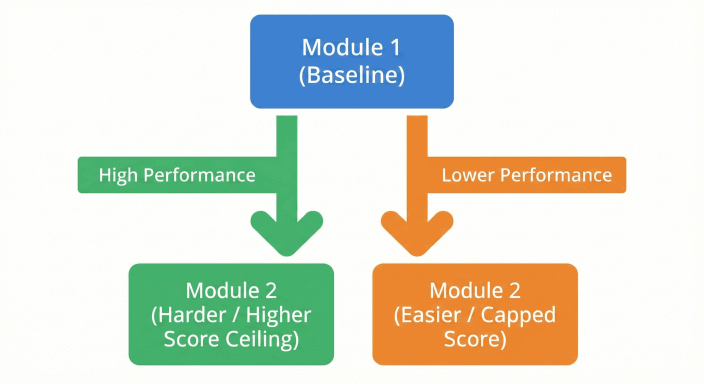
- Module 1: A mix of easy, medium, and hard questions. This is your baseline.
- Module 2: The difficulty of this module depends entirely on how you did in Module 1.
- The Hard Path: If you perform well in Module 1, you unlock the "Hard" Module 2. This is where the big points live.
- The Easy Path: If you struggle in Module 1, you get an easier Module 2. Here is the trap: If you are on the easier path, your maximum possible score is capped (usually around 600-650 per section), no matter how perfect you are in the second half.
The Golden Rule: You cannot afford to be careless in Module 1. A silly mistake on an easy question in the first module hurts your score much more than missing a hard question in the second module.
Case Study: The Tale of Two Students
Let's look at a realistic scenario to prove why "counting errors" doesn't work anymore.
Meet Alex and Sam. They both took the Math section (44 questions total). They both missed exactly 5 questions.
Student A: Alex (The "Careless" Genius)
- Module 1: Missed 3 easy questions (careless calculation errors).
- Module 2: Routed to the easier module. Got almost everything right, missed 2 hard ones.
- Result: Alex is capped. Because he messed up the baseline, he never got the chance to earn the high-value points.
- Estimated Score: 640
Student B: Sam (The Strategist)
- Module 1: Aced it. Missed 0.
- Module 2: Routed to the hard module. Struggled a bit and missed 5 really tough geometry questions.
- Result: Because Sam unlocked the hard module, she is playing for a higher bracket. Even though she missed more questions in the second half, she missed harder questions.
- Estimated Score: 730
The Reality Check: Sam missed the same total number of questions as Alex (or even more in some simulations), but scored nearly 100 points higher.
Use Our Tool: This is where the SAT Calculator shines. You can simulate these scenarios to see how "Hard Module" vs "Easy Module" affects your final number.
What is a "Good" Score in 2025?
With the Digital SAT, score distributions have shifted slightly. Because the test is shorter and less fatiguing, some data suggests the "middle" of the curve is rising.
However, top-tier colleges are also shifting back. Schools like Yale, Dartmouth, and Brown have reinstated standardized test requirements.
| College Tier | Target SAT Score (2025) | Strategy Focus |
|---|---|---|
| Ivy League / Top 10 | 1520 - 1600 | Perfection in Module 1 is mandatory. Can miss 1-3 questions max in Module 2. |
| Top 50 State Flagships | 1350 - 1480 | Secure the "Hard" Module 2, but partial credit isn't as punishing. |
| National Average | 1050 - 1100 | Focus on mastering the fundamental concepts in Module 1. |
3 Practical Strategies to Beat the Algorithm
Now that you know how the score is cooked, here is how to maximize it.
1. The "Desmos" Advantage
The Digital SAT embeds the Desmos graphing calculator directly into the math section.
- The Hack: Many "Hard" algebra questions in Module 2 can be solved in seconds by typing the equation into Desmos rather than doing the algebra by hand.
- Action Item: Spend 50% of your math study time learning Desmos shortcuts. It saves time, which reduces panic-induced errors in Module 1.
2. Front-Load Your Focus
On the paper test, you had to sustain energy for 3 hours. On the Digital SAT, the first 15 minutes of each section (Module 1) are the most expensive minutes of your life.
- Strategy: Double-check every answer in Module 1. If you run out of time in Module 2, it hurts less than making a mistake in Module 1.
3. Don't Leave Blanks (Obviously)
There is no penalty for guessing. If you have 10 seconds left, pick "C" for every remaining question. But more importantly, use the "Mark for Review" tool wisely. The digital interface allows you to flag questions. Do the easy ones first to bank points, then loop back.
Final Thoughts: The Calculator is Your Compass
The Digital SAT is a beast, but it is a tameable one. It rewards accuracy and strategy over brute-force memorization.
Don't obsess over "how many did I miss?" Instead, focus on "did I secure the difficult path?"
Use our SAT Score Calculator to run "What If" scenarios.
- What if I ace Module 1 but bomb Module 2?
- What if I make 2 mistakes in Module 1?
Seeing these numbers will help you understand that accuracy is the new speed. Good luck!
References & Further Reading
- The College Board - "The Digital SAT Suite of Assessments Specifications Overview."
- Compass Education Group - "Digital SAT Scoring: A Deep Dive into Adaptive Testing."
- Yale Admissions Office - "Standardized Testing Policy Update 2024."
(Disclaimer: This article is for educational purposes. The SAT scoring algorithm is proprietary to the College Board and subject to change. Our calculator provides estimates based on available data and IRT models.)
Frequently Asked Questions
Why do two students miss the same number of questions but get different scores?
The Digital SAT uses adaptive testing. Your performance in Module 1 determines whether you get a harder or easier Module 2. Harder modules contain questions worth more points, so missing questions in a hard module can still result in a higher score than perfect performance in an easy module.
What is Item Response Theory (IRT) in SAT scoring?
IRT is the statistical model used by the College Board to determine question difficulty and point values. It means not all questions are worth the same—harder questions answered correctly are worth more points than easier questions.
How does Module 1 performance affect my maximum score?
If you perform well in Module 1, you're routed to a harder Module 2 with a higher score ceiling (up to 800 per section). If you struggle in Module 1, you get an easier Module 2 with a capped maximum (usually around 600-650 per section).
Can I use the SAT calculator to predict my score?
Yes, our SAT Score Calculator accounts for adaptive module routing and can help you simulate different scenarios to understand how Module 1 performance affects your final score potential.
What is a good Digital SAT score in 2025?
For Ivy League schools, aim for 1520-1600. Top 50 state flagships typically require 1350-1480. The national average is around 1050-1100. Remember, perfection in Module 1 is mandatory for top-tier scores.
How can I maximize my Digital SAT score?
Focus on accuracy in Module 1 (double-check every answer), learn Desmos calculator shortcuts for the Math section, and use strategic time management to ensure you unlock the harder Module 2 path.
SAT Calculator Team
The SAT Calculator Team specializes in data-driven analysis of SAT scoring and college admission trends.
Found this helpful?
Share it with others preparing for the SAT!
Related Articles
Hidden Math Behind Digital SAT Score Calculation
Learn why Digital SAT questions aren't equal: understand adaptive module routing, IRT scoring, and how Module 1 mistakes cap your score. Get tips for 2025.
Case Study: Why 5 Mistakes Can Mean 680 OR 760
Learn why identical mistake counts can create 100-point score gaps on Digital SAT. Discover adaptive module routing and strategic test-taking rules for 2026.
Mastering Desmos Calculator: Digital SAT Math Secret Weapon
Learn Desmos calculator techniques for Digital SAT Math: intersection, slider, regression methods. Save time and boost your score with visual problem-solving.
Get More SAT Tips
Get the latest SAT tips and strategies delivered to your inbox